Saturday, 1 June 2013

ranting on the ferry.


I have spent all of my drive from Kaikoura to Picton philosophising about what I would write in this blog and now that I’m here and waiting in line for the ferry I just feel exhausted and drained. But I will write, we’ll see how long my laptop battery lasts anyway.

I’m on my way to fieldwork one placement which is pretty exciting as although I have been studying OT for almost two years now (part time) I haven’t yet seen an OT in action. This however means that for a the last couple of weeks I have been in assignment land and lets say, somewhat stressed. One of these assignments was to write a concept review for a few different occupational science concepts; occupational identity and occupational satisfaction; occupational transition; occupational disruption and deprivation. I really enjoyed reading and thinking about these concepts but I loathed breaking them down for an assignment and regurgitating them. I did read at least a million journal articles about the ‘fluffy’ side of OT and lots of them were really interesting if not applicable to my assignment.

So now, what I want to do is apply those concepts to my occupation of making wine.

My lecturer said at the start of the year that basically occupational scientists just chuck the word occupation in front of a word to own it as something to do with occupation. My tactic is therefore just ignoring the word occupation. In my opinion, and from I’ve read by Ann Wilcock (a wonderful occupational scientist) pretty much everything humans do and be is an occupation. An activity that brings purpose and meaning. We are occupational beings. Therefore I more like to think of my studies as a therapist in enabling and supporting meaning and purpose through activities, is my current view. Therefore I’m excited about my placement starting on Tuesday to see how this is actually applied. A few different lecturers (especially my Occupational Science lecture) have warned that in practice the big picture stuff can be lost for just enabling activities of daily living (ADLs), I don’t know if this is a shortcoming because of institutional attitudes, lack of funding, time or resources, or it’s just easy to fall into a rut and method of practise. It’s probably a mix of all. Anyway, I really enjoy all this philosophical, ‘fluffy’, big picture part of Occupational Therapy (I just hate doing the assignments) and so being the optimistic, naïve undergraduate that I am, I hope to apply it and save the world. This is also part of my distrust and dislike of diagnosis and medication. I hope to be able to support people in a mental health setting through their particular limitations and challenges through just supporting the process of creating meaning and purpose through their own chosen occupations, and therefore improving their well-being and health. Let’s hope I’m not just being optimistic and naïve. I’m sure I also have a lot to learn about mental health, I’m anticipating having to challenge my opinion against diagnosis and medication which is fine. Challenging my opinion should lead to growth and better understanding.

Anyway, that rant over. It’s just what I’ve been thinking about on my long drive. What am I studying? Why am I studying this? What does it mean to me? Where do I want to go with it?

So what does this mean in relation to wine? And where am I at with my wine making?

I haven’t been doing much as I have been in assignment land and with timing of going away for 6-7 weeks I couldn’t get much going. I have racked my yarrow mead into another demijohn to get it away from tainting sediment (my friend is making bread from this sediment). We had a little taste. It’s quite dry and sharp and I can’t imagine drinking much of it at once however it was still an enjoyable experience. I still can’t work my hydrometer but I added more honey to sweeten it and feed whatever yeasts are still in the brew. I still don’t know what I’m doing but I’ll just go along with whatever I think is a good idea and hope for the best.

What does this wine making adventure mean in terms of my occupational identity and occupational satisfaction? Well it ties in greatly with my interests in cooking, nature, gardening and potentially partying (not that I encourage binge drinking). I identify strongly with learning how to use what resources I have in my environment for food and medicine. I hope to lessen my impact on the environment by making conscious decisions regarding what I consume. I guess you could label my identity as ‘hippie’ however I don’t like the term and think it’s better suited as a shortening of hypocrite rather than hipster (its origin word) and that statement probably shows I’m too cynical and dark to be a true hippie. Maybe ‘greenie’ is a better label but then that makes me think of yuppies who buy eco friendly cleaning products and donate to greenpeace. Basically I can poke holes in any label put on my identity, and my identity is unique to me, Keri Simone McMullan alone.
So back to the wine, I certainly identify with this new occupation strongly and I have been deriving a lot of satisfaction from it. I am proud of my beautiful demijohns and smile whenever I pass them in the washhouse. I have been telling everyone about it and my hopes. This unfortunately means that everyone wants to taste it so I’m going to have to make a lot but that’s ok, I enjoy the process and have lots of recipes I want to try. I imagine that I will be incredibly satisfied and proud of my end product once it’s ready. I already get so proud over certain meals and preserves I have made with my own garden produce and weeds.

Occupational transition is when one goes through a transition in their occupations. This is a very normal part of life process such as graduating from school into tertiary education, becoming a parent, migrating. At the moment I am transitioning from someone with no knowledge of how to make wine to someone with basic experience. I hope to transition to someone who can craft delicious wines out of a variety of different wild sources. I hope to gather more information for problem solving and feeling more at ease with the process. Then I hope to transition to someone with many delicious wines to share with friends and family. Plus gather more understanding and knowledge of ‘weeds’ and their uses along the way.

Occupation disruption and occupational deprivation are certainly two experiences I haven’t really had so far in my wine making adventure. Occupational disruption is when there is a short-term halt on the ability to engage in a chosen occupation, this could be a broken bone or a child being born. The emphasis is that after a short time things will return to stability or normality. Occupational deprivation is a much longer experience and in my last assignment I listed these categories of factors contributing to occupational deprivation; geographic isolation, incarceration, refugeeism, stereotyping and problems with employment- unemployment, underemployment or overemployment  . Note these factors are external forces.  A disability is not a factor contributing to deprivation rather it may be an external factor such as no wheel-chair access to a building that deprives an individual with a disability. Like I said, I don’t really think these two concepts can really apply to my situation. I guess my wine making has been disrupted by the time I am spending away on fieldwork but this doesn’t concern me. I could imagine that if I were deprived of the ability to make wine it wouldn’t really impact my overall wellbeing and health, rather more important activities would be my focus. If I were incarcerated in prison (I can’t think of any reason why this would happen), I would be far more concerned about my inability to be a mother rather than make wine. Besides, I’ve talked to someone who was in prison a long time ago, and they managed to make potato wine without being noticed.

So that’s a “quick” interpretation of how my wine relates to concepts within occupational science and how occupational science relates to my studies and how my studies relate to me. It’s so much easier to write when I don’t have to reference or say specific things or worry about being marked.


Ka pai for getting this far!! Almost 1500 words.

Just a brief outline of my future hopes. When I get back to Dunedin in mid-July I will start preparing to do my 20L dumpster brew. Hopefully this will be at zinefest and I can have people to share the experience with. Just sent a message to try and organise this.
Plus come August I get another brew going as I will bottle my elderberry wine in September and will have another demijohn free. I’ve been eyeing up all the beautiful gorse flowers as I drove up the country and would love to make some however it will be up to what’s in season in August . There are lots of different flower wines I can make in spring. I’d also love to make a nettle wine but I don’t know where I’d find enough nettles.

No pictures or links yet as I’m on the ferry and they have limited wifi options.

Tuesday, 16 April 2013

Mead in the demijohn

 This photo brings two thoughts to mind;
A weed is just a plant in the wrong place
And, beauty is in the eye of the beholder
Taman brought these dandelion heads inside the other day, he wanted to put them in a vase and he wants to grow them too. Interestingly one of his friends has also planted dandelion seeds but I don't think Taman knows that. He's growing an interest in the natural world and the natural processes. Come spring, dandelions will be a very welcome weed in my garden as I plan to make dandelion wine.

Here is my yarrow mead in the fermenting jar. I strained it on Saturday and put it in the bottle only to discover that the bung (this pink, rubber cork which holds the airlock) was missing from Taman's pocket. My fault for leaving it in his pocket, he was just so keen to be part of the bung buying process, he's fascinated by wine making. Either that or he's trying to sabotage it, he did snap my hydrometer in half and then hide it under a couch cushion. He hasn't come to understand that when you're dishonest you need to be consistent. So while he hid the evidence, as soon as I asked where my hydrometer was he lead me to it and told me he broke it and then hid it. How can you be annoyed by that kind of innocence?

Anyway, I covered the top of the fermenting bottle with a couple of layers of gladwrap and put the airlock into that. My friend who works at the brew shop advised me to do that. The gladwrap didn't give a tight seal but the first few days of fermentation are so fast that there's usually a constant layer of carbon dioxide keeping oxygen and potential contaminants such as wild yeasts away from the brew. On Monday  I swiftly went down to the brew shop and got a new bung and now it's bubbling away quite happily and the washhouse smells of fermentation again.

There was actually just enough juice once I'd strained it. When I had added the water originally I was worried that I had put far too much in but once I taken a sample for my hydrometer reading it was perfect. My hydrometer read that it has the alcohol level of a table wine. I'm not really sure what that means or the purpose of the activity but I'm sure with time and expertise it'll become apparent.

So now to leave the brew for another 2-3 weeks until after the holidays and then rack it off into another demijohn to avoid the sediment tainting the flavour. I'll need to buy another demijohn but this means I should be able to get into a good swing of having 3 brews on the go. I can make the 3rd brew a few weeks before the 1st brew is ready to be bottled and then I'll have the 1st demijohn to rack the 3rd brew into when it's time. If that makes sense. And I do think I will need to have 15 litres of wine on the go at a time, there are so many people interested in my wine it's going to disappear quickly and there are so many different recipes I want to try and it's such a long process of at least six months. Do I need to justify this more?

I wonder when I'll get the guts and the materials together to make a 20L wine... Maybe a dumpster brew.

So that's my learnt occupation put to rest for another few weeks... time to work on my bloody occupational science assessments.

Wednesday, 10 April 2013

Yarrow Mead

I have put down my next brew of yarrow mead. Mead is a wine made with honey, it has a very strong flavour and is drunk like a dessert wine.
I haven't documented this very well nor taken photos of the process as I'm not nearly as nervous as last time. In fact, my confidence may be my demise with this brew as I realised that I hadn't sterilised a couple of pieces of equipment. Ah well, too late now.

This is the recipe I used: http://www.celtnet.org.uk/recipes/brewing/fetch-recipe.php?rid=yarrow-flower-wine
I made a couple of adjustments which I hope won't be too detrimental. Instead of oranges and lemons I used citric acid (maybe I should have used tartaric). And I added a campden tablet to the brew so that it was sterile. Unfortunately I didn't listen to my instincts that there was too much water in the recipe and sure enough, upon reading the root recipe (basic mead recipe) I realised that instead of 5L of water I should have used only enough water to make the whole brew 5L. You live and learn.

It will be a shame if the brew doesn't work as I used 1.5 kgs of organic raw honey which isn't cheap. It comes from the farm where I buy my raw, fresh milk and they have since sold out. Most of the honey is clover but also 500 grams of manuka, I didn't want to use full manuka as it has a very strong flavour and is expensive.

The main ingredient of course is yarrow.
Yarrow is a "weed" that grows all over Dunedin. I collected my flowers from the Leith River banks as there I knew it hadn't been sprayed and was not near a road so not covered with exhaust. (and further upstream from scarfieland and all the rubbish which is thrown in). The area was also covered with hemlock which is very poisonous so I had to be careful with Taman but it only took one explanation before he was telling me to be careful and correctly identifying the hemlock and the yarrow. We collected a bag full and Taman sang a yarrow song which he'd made up. He promised to record it when we got home but has since refused. The morning felt like a very wholesome gathering activity as did the elderberry collection.
The whole shopping bag was only just enough for the two litres we needed. I had thought I'd have some left over to dry for yarrow tea, a useful herb for colds, congestion and fevers. It's the end of the season too so a lot of the flowers were getting a bit passed ideal. It's not really an ideal time for me to be putting on this brew as I'll be away in a couple of weeks but I wanted to get it going before the yarrow season finished.

This clip has taught me a lot about yarrow.

Yarrow is almost globally spread and has a long history of use. Yarrow can be used for many things, it has antibiotic properties so is good for cuts, burns, bladder infection, kidney infections. It can be used to stop nose bleeds. It can lower blood pressure. Yarrow is also one of the best fever reducers, along with peppermint and elderflowers. So yarrow tea is amazing for a cold with both antibiotic and fever reduction. Yarrow has been used with hops, mugmort, wormwood and other herbs to brew beer which preserves the beer and adds the bitter flavour. (There's an interesting history of why beer is most usually made of hops).


Todays research stint had me watching this clip which I enjoyed, the singer is Bethany Yarrow, daughter of Peter Yarrow from Peter, Paul and Mary. I have a feeling that as I research different weeds which often have rich folklore histories and medicinial uses, I will be listening to a lot of folk music.

I watched a few clips for "Yarrow", a traditional Scottish ballad. Yarrow refers to a place not the plant.


Then while reading about the song on wikipedia I saw that a band called Scatter had released their version of Yarrow and I tried to track that down as it sounded like a band I'd like. I couldn't find their version of yarrow but I found a couple of different tracks by them. I really like free noise, improv music.

It's amazing how far my distractions will go when I should be writing an assignment for occupational science on occupational identity and occupational satisfaction.

Saturday, 6 April 2013

Racking off

Today I racked off my wine. This is to remove too much sediment which can taint the taste of the wine. Simply I just used gravity to transfer the wine from it's demijohn to a new one and then topped it up with water. I still don't know how to use my hydrometer but I'll try and work it out and then I can work out if I need to put more sugar in or not.

I was a bit nervous with this process as I don't like touching the wine. I'm not very confident that the wine will work. However when I was sucking wine up the tube to rack it off I got a little taste and it's actually delicious already.
I got another demijohn from my other grandma (not the one who gave me the recipe book). This bottle is from my great-granddad's wine making efforts. I thought about collecting grapes from his vines too but it doesn't fit with my wild wine focus. I'll leave that project for the future.
This afternoon I'm going to collect yarrow heads and get started on my next brew, yarrow mead.

Friday, 22 March 2013

Fermentation Time


The wine is in the demijohn and it's bubbling away beautifully! My washhouse has slight pleasant smell of fermenting sugar and fruit and it looks rather beautiful I think. It's also exciting to watch the bubbles bubbling everytime I walk past. I was a bit concerned that wine had gotten into the airlock but apparently that's not really an issue.

Yesterday I strained it which I thought would be a quick enough job but to really squeeze out all of the juices it took me over an hour. I need a bigger funnel too. So now to sit and wait until it stops fermenting then bottle it and wait and wait and wait several impatient months until it's done. I sure hope it's good.

I've started thinking about what other wines I will make. Elderflower, gorse flower and dandelions won't be ready until Spring and I want to get an least one other brew going before then. I'm going to keep researching other 'weeds' that I can use but so far I haven't found much. Perhaps parsley at a stretch because there's a lot on campus and I know fields of wild parsley in Wellington.

I'm also considering going down another tangent and focusing on using materials that would normally not be utilised which encompasses the 'weeds' but could also include dumpster food.

Dumpster diving is collection of food which supermarkets have thrown out due to being past the best before date, superficial damage to packaging and sometimes it's just the end of the line (I found five heaters and two soda streams once as the shop changed seasons or models or something, there certainly wasn't anything wrong with any of the products). The food is usually still in delicious condition but due to bureaucracy and capitalist drive for consumption it's thrown into the dumpsters and goes to waste. Food in landfills is not a useful or healthy ingredient, the decomposition of food is faster and therefore interferes with the decomposition of other materials. 23% of methane emission in the USA are from food in landfills. Food wastage is massive problem all over the world, in the USA 40% of all food goes uneaten (NRDC, 2013). This is appalling given widespread poverty and hunger.

So without wanting to get into too much of a rant, I think it would be appropriate for me to make wine out of dumpstered ingredients over the winter when there's no weeds to make wine from. Luckily I don't need to be too picky either as I've got recipes for all sorts; apples, beetroot, bananas, carrot, celery, kiwifruit, lemon, parsnip, rose petal, tomato and many, many more. Just fermenting stuff and sugar makes wine, kind of, the question is if it actually tastes good. As dumpster diving is slightly illegal, I may just say that the food has been unknowningly upcycled to keep it a bit more politically correct for school.

Here's a really cheesy short clip about dumpster diving but it portrays it quite well.

Here's a link to Wellington initiative which collects food after the vegie markets and gives it back to the community through several food banks and charities.


And just while I'm on a roll here's a couple of links to easy ways to make a compost bin for your flat so that you can let your food wastage decompose where it should do.

If only saving the world was really as easy making wine, dumpstering and composting. But at least they're interesting and rewarding activities.


References
Reducing Food Waste and Losses in the U.S. Food Supply | NRDC. (n.d.). Natural Resources Defense Council – The Earth’s Best Defense | NRDC. Retrieved March 22, 2013, from http://www.nrdc.org/food/wasted-food.asp

Sunday, 17 March 2013

Mushing elderberries


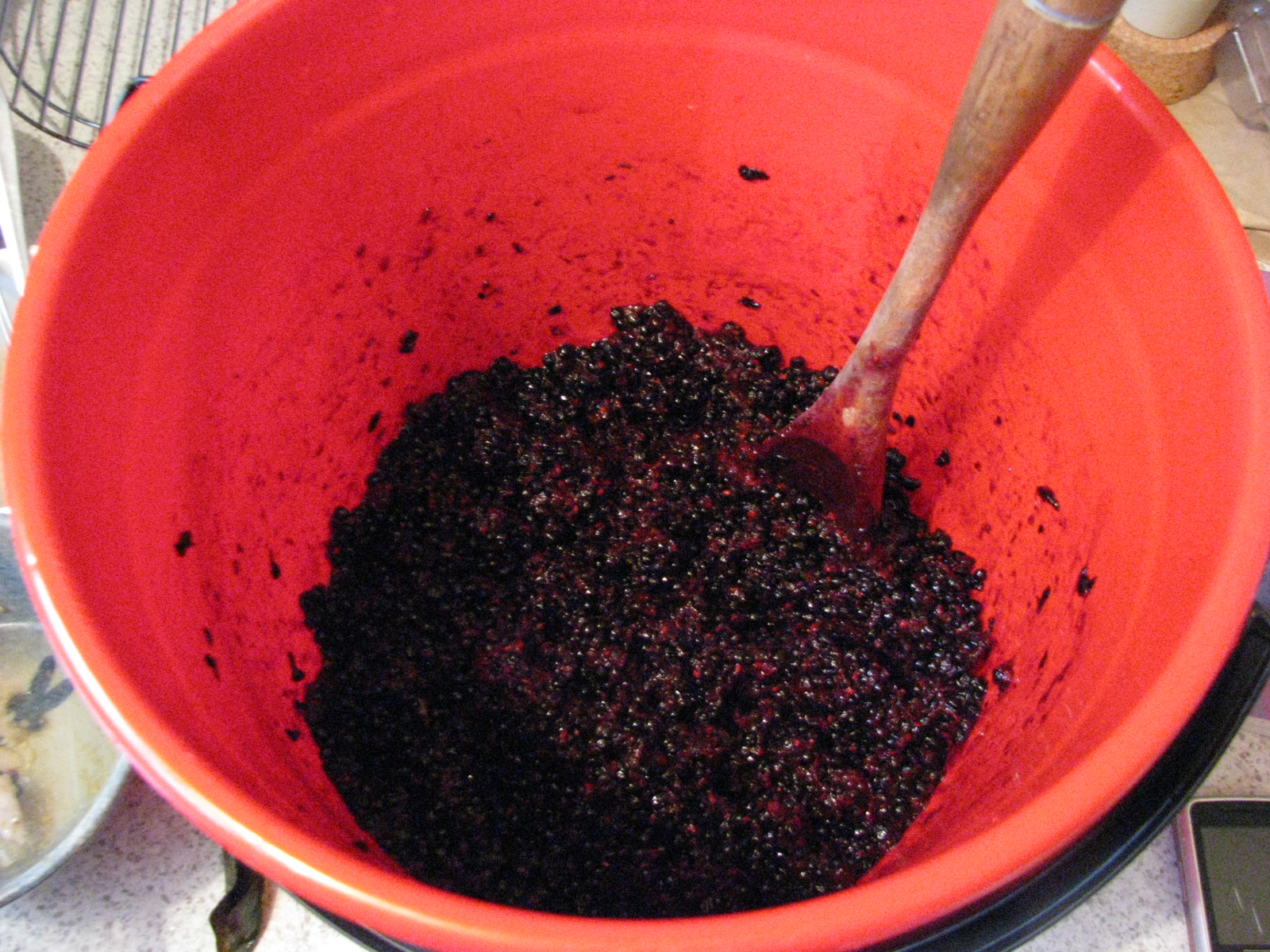
Today I finally began the actual wine making. This was just crushing elderberries in a sterilised bucket with a sterilised spoon then adding boiling spring water, and a campden tablet and 1tsp pectinase when the mixture had cooled down. Then covering it with a lid. Tomorrow around about 5pm I'll add the yeast, nutrient, citric acid and vitamin B1. Then I'll leave it for a couple more days before straining, adding sugar and putting into demijohn.

I had left over elderberries so I made some elderberry cough syrup with raw manuka honey and spices. It smells delicious and should be useful over winter.

Yesterday I had collected most of the bits of pieces but I was still feeling a bit absent due to lingering cold so I didn't click that the beautiful glass demijohns my brother had lent me are for 20Ls. If I wanted to make 20L of elberberry wine I'd need almost 8kgs of fruit, I'd also need a whole week at my current rate of collection and preparation. It's not going to happen so I'll head back to the brew shop to get a modest 5L jar.

The large jars did get me thinking about potato wine. I have potatoes that grow wild in my garden, so they almost count as a wild harvested material. I'd certainly have enough to make a 20L brew. Question is, if there's anyone who wants to drink 20 litres of potato wine. At this point potato wine is the in the 'very experimental, I'm not convinced' category. Parsley wine is looking intriguing and it grows all over campus.

No playlist for today. I was kind of listening to national radio, mostly listening to the most welcoming sound of rain outside.

Friday, 15 March 2013

Recipe decision made

I'm sipping on a delicious whiskey mac (I'm sick, my Grandma swears by it!) and am making the last few decisions before I launch into my first brew. Tonight's soundtrack is good old Janis. I figure she would have drunk a lot of elderberry wine in her time.


I've decided on my recipe. I had spent an hour yesterday painstakingly piecing together a recipe from a book on my kindle where the recipe was kind of like those pick-a-path books. To make Elderberry wine use this recipe but replace this with that then follow the method over there and in that method over there you have to find the explanation on how to do this thing with that, unless of course you're doing this with that, then you must start again. You get the idea and it's made even more difficult on a kindle. Then I hadn't even got around to converting imperial to metric before I realised I was way too sick to be at school and made my way home to bed. Anyway, then this morning, when I came home from my presentation to my class about my project, I came home to the glorious site of a parcel in my letterbox. My grandma has sent me her two recipe books for home brew and wine making and in "Home Brewing and Wine-making for New Zealanders" by Chris Reading is the perfect recipe for me, and it's even in metric measurements.

This is my recipe,
1.8kg elderberries (strip from stalks)
1.3kg sugar
1/2 tsp citiric acid
yeast, nutrient, pectin enzyme, vitamin B1
water to 4.5 litres
-Crush elderberries and add boiling water. Cool.
-Add 5ml SMS [one Campden tablet], plus pectin enzyme.
-Leave for 24 hours. Take specific gravity reading with hydrometer.
-Add yeast and other ingredients (except sugar).
-Leave two or three days, or longer if you wish to use as blending wine for port style (high tannin).
-Strain, add sugar and ferment.

There are a few more tricks to that but I'll explain them as I do them.

My mission for tomorrow is hunting and gathering. I need:
- A large plastic bucket
- Glass fermenting vessels/ carboys/ demi-johns
- Corks and bungs
- Fermentation lock
- Hydrometer
- Syphon tubing
- Corking machine (possibly, I'm actually going to worry about bottles later)
- Bottle brushes
- Muslin
- Campden tablets
- Yeast
- Nutrient
- Citric Acid
- Pectin enzyme
- Vitamin B1
- Bottle sterialising stuff (this is a technical term)
- Spring water
- 200 grams more elderberries (though I might collect more to make a cough syrup for winter coming up).

For a lot of the equipment, I'm hoping to borrow off my Mum or eldest brother. I'll then make my way to a brew shop to get the last of the things I need. Then I should be able to get stuck into it tomorrow or Sunday.

The presentation went well for considering how unprepared and sick I felt.
I read through the assessment to come at the end of the year and I did wonder how I will make an appraisal of the potential value of my learnt occupation within a service that focus on on-going participation in occupation. Somehow, I don't imagine that making homemade wine would be seen as a valued occupation in most community services. However the wine isn't really the focus of my interest, it's more about using the resources available to me in my environment. As far as I'm aware, a huge component of occupational therapy is about using the resources available to the service-user in their environment (social, physical, economic, institutional) to the full potential to provide well-being for the service-user and community. So there's one correlation and I'm sure I'll find more as I go and learn more about occupational science.

Already this small topic has had me interested in other topics somewhat related.
Yesterday as I tried to piece together my recipe I listened to a couple of different interviews with Kim Hill

(oh wow, I just about flipped out as I accidently closed the window to this as I was writing it. I only swore a couple of times for trusting technology for my record keeping. However, technology is more clever than I am and it autosaves! I'll carry on now )

So as I was saying, I was listening to Kim Hill interviews. The first one was about a guy, Michael Reynolds who makes Earth Ships, self-sufficient houses made of largely recycled materials (bottles, tyres) with incredible heating systems (as in none by the sun and good design) and recycling of water systems. He's made a doco which I've seen so I was only half listening but is certainly worth sharing. And it's all about using the resources available to their best potential.
http://www.radionz.co.nz/national/programmes/saturday/audio/2547960/michael-reynolds-earthships.asx

I also attempted to listen to this interview but I was too sick to concentrate, it does sound very interesting though. Discussing the true value/monetary value of food. I'm going to try and listen to it again tomorrow.
http://www.radionz.co.nz/national/programmes/saturday/audio/2547288/frederick-kaufman-financialised-food.asx

Now for the best medicine against colds, off to bed.